
The latest from my posts
May 2026
The Shovel Sellers of LinkedIn
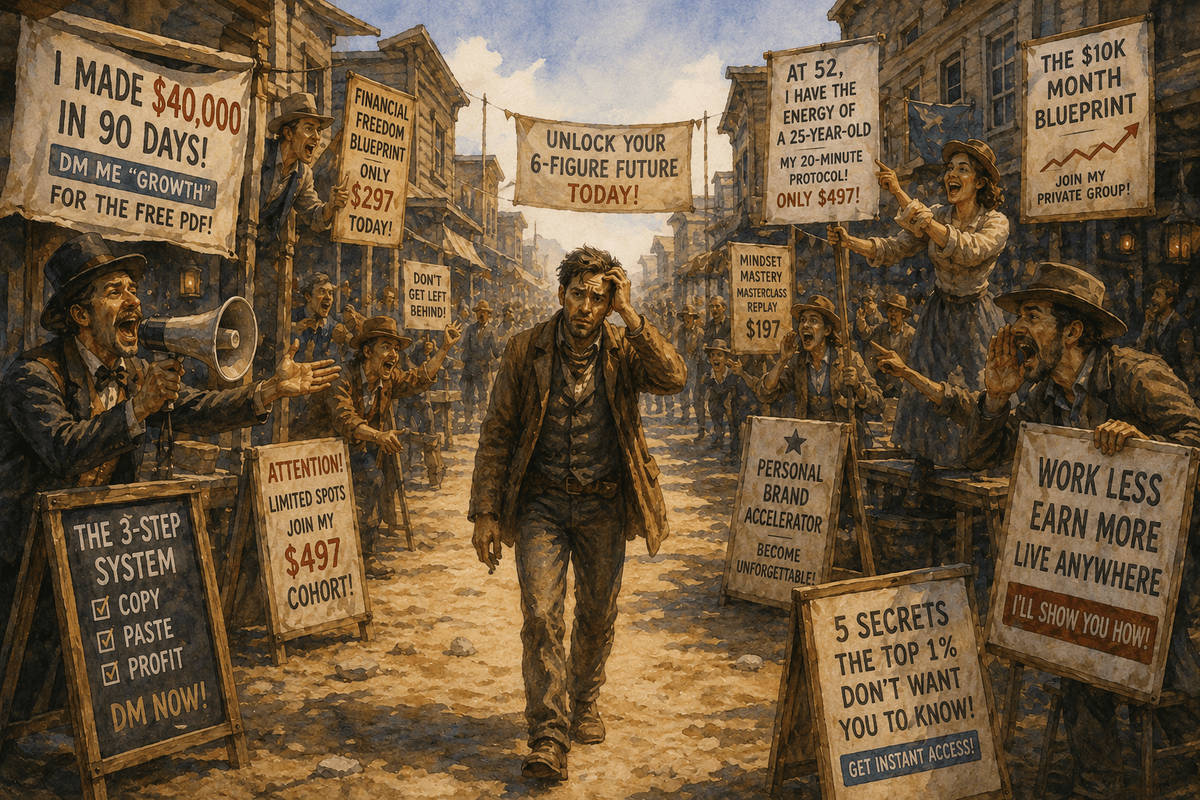
In May 1848, a San Francisco shopkeeper named Sam Brannan ran through the streets holding a glass bottle of gold dust above his head, shouting "Gold! Gold from the American River!"
He had not discovered it. He had not mined it. What he had done, before his one-man parade, was quietly buy up as many picks, shovels, and pans as he could find in San Francisco.
His store sold up to $5,000 a day to the prospectors his announcement summoned. He never panned for an ounce. He did not create the gold — but he ignited the rush, and he sold the tools to chase it.
Scroll LinkedIn for ten minutes and you'll find his descendants.
"I made $40,000 in 90 days. Here's the exact system — DM me 'GROWTH' for the free PDF."
"The 5 morning rutines of every seven-figure founder."
"At 52, I have the energy of a 25-year-old. My secret: a 20-minute protocol I now teach in a $497 cohort."
These are the shovels. And the people buying them are tired, anxious professionals who are not stupid — they're scared. Scared of AI eating their role, scared of retirement math that doesn't add up, scared of being the last person at the office to figure out what everyone else apparently already knows. Underneath all of it is the oldest motivator there is: the fear of loss. That is what FOMO actually names. The grift works because the fear is real.
The tell
The cleanest signature of a shovel-seller is a logical contradiction hiding in plain sight: if the method actually worked, the teacher would not need to teach it. Some people teach for honest reasons — they enjoy it, they want to leave something behind. But the more miraculous the method sounds, the less plausible it becomes that recording a Loom video (one of many tools for making short videos) for strangers is the best use of the teacher's time.
There is also a deeper move underneath the grift. Real life keeps handing us problems that don't have a clean answer — staying relevant as the work changes, raising a child who turns out well, growing old without disappearing. These are the kind of challenges you adapt to, not the kind you solve. The shovel-seller repackages them as technical problems: five steps, one protocol, a checkout page.
If you really cracked passive income at $40,000 a month, the rational move is to deploy more capital into the system. If you really have the body of a 25-year-old at 52, your time is worth more in a gym, a clinic, or a research lab than on a webinar funnel.
The course is the income. The audience is the gold.
A founding father
This genre has a founding father, and it is worth naming him: Napoleon Hill, whose 1937 book Think and Grow Rich remains widely described as one of the bestselling self-help books ever published.
Hill built his entire authority on a single story. In 1908, he claimed, Andrew Carnegie — then the richest man in the world — personally commissioned him on a twenty-year unpaid mission to interview five hundred millionaires and distill the universal laws of wealth.
David Nasaw, the Carnegie biographer, later said he found no evidence of any kind that Carnegie and Hill ever met. Hill only began telling the story publicly after Carnegie died in 1919.
Here is the part that matters. Think and Grow Rich did make Hill rich — for a while. It is also the only thing that clearly did. Outside the success literature that made him famous, Hill's business record was littered with failed ventures and fraud accusations. The man who claimed to have decoded the laws of wealth could not apply them to anything except selling the book about them.
The template hasn't changed in ninety years. Only the platform has.
Why this is worse than annoying
A course that takes $497 is not the worst thing on the internet. The harm runs deeper than the credit card charge.
It teaches people that depth is a marketing problem. That mastery is a five-step list. That the answer to a hard life question is always one purchase away. It trains a generation of professionals to mistake confident packaging for actual knowledge — and then to produce confident packaging themselves, because that is what seems to work.
It also crowds out the real thing. A craftsman who has spent twenty years getting good at something may teach — but usually with specificity, limits, and scars. The shovel-seller sells certainty, speed, and transformation without cost. The honest voices get drowned out by the loud ones, and the platform starts to feel like a marketplace where nobody is actually selling anything except the appearance of having something to sell.
What's actually worth your time
_________________________________________________________________
Jan 2026
Ideas about the death of a loved one (Faith based)
Note before beginning: This text is not intended to provide comfort to someone who has recently lost a loved one. The weight of that reality far exceeds the possibility that the ideas presented here might ease that pain. It is meant for those who witness such deaths, who don’t know what to think or what to say to the bereaved. And who sometimes wander in their own confusion.
Introduction:
Saint Augustine said: If you think you understand God, then what you’re thinking is not God. (1) It is evident that if God is truly God, then He is infinite. And since we are finite, it doesn’t seem logical to believe we can approach Him with our thinking alone, whose most typical tool is reason.
That being said, God is love. And as His children, made of His lineage (2), we carry within us this gene of love. We are creatures of love and for love, even though we are temporarily “fallen,” partially separated from that state of grace (3).
I say all this because, in a certain way, we can “understand” God. Not with our reason alone, but through love—and the bridge there is faith. (4) Jesus, in inviting us to be One with Him, gives us that capacity: to “understand” the will of the Father. (5) That is how He willed it. Saint Paul says it: It is no longer I who live, but Christ who lives in me. (6) The Church, as an aspiration to holiness—and reinforced by great saints—says: Let us become other Christs; Christ Himself. (7)
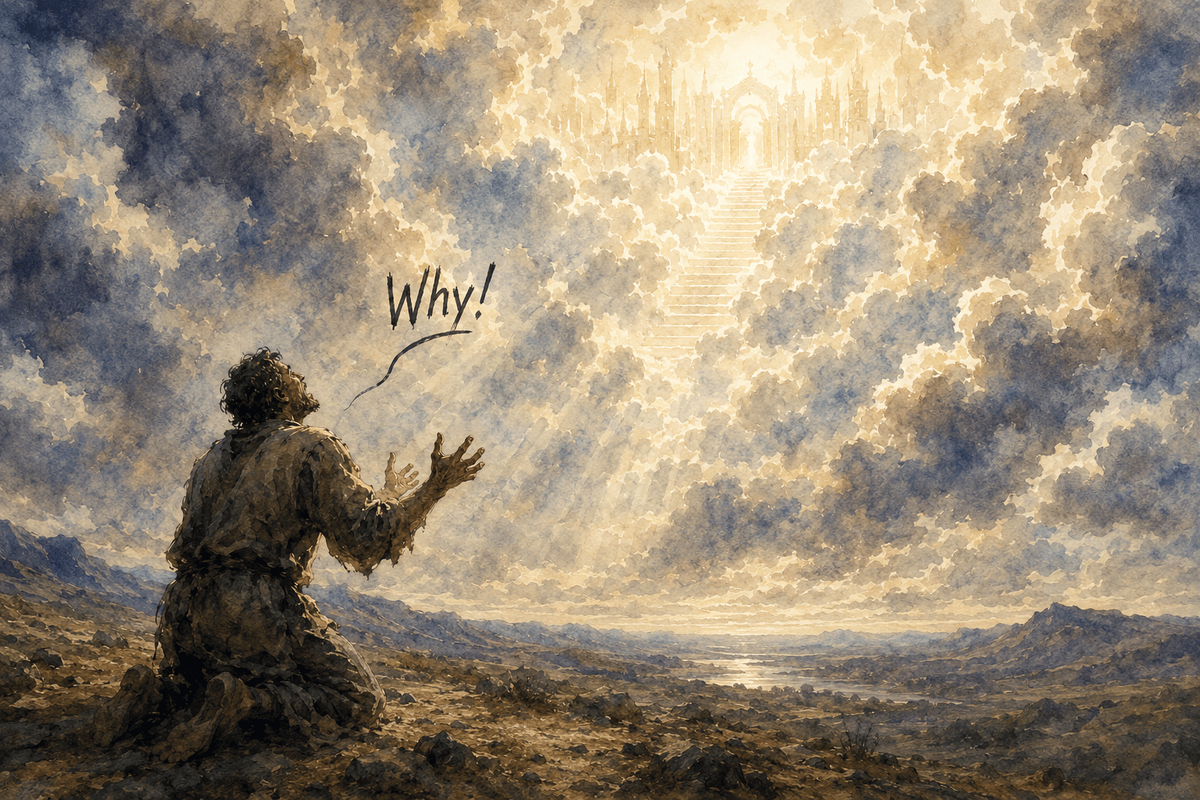
With that idea in mind, I now turn to speak about the death of a loved one. Much is said in popular Christian quotes regarding the will of God and the contradiction that death presents us. If everything fits within God’s will, and I lose someone I love: Was it because God wanted it? Did God want to kill my wife in an accident caused by a drunk driver? Did God want the tsunami to wipe 300 people off the face of the earth because it was the “right moment” to take them from this world? Do all our loved ones die because God “takes them,” and for that He kills them indirectly with His power, making it seem like part of life?
I believe not.
But we also cannot say that God is powerless and that what happened is foreign to Him. There is indeed something mysterious here—something that is impossible to reconcile fully and cannot be rationalized. (8)
Why this text? Because in popular christian culture, many poor explanations and overused phrases circulate at funerals that do nothing but confuse and sow doubt about God’s love.
Here we go:
1 – The Will of God
Indeed, God is the one who sustains all of reality. Everything depends on Him. Given His infinitude, He never loses control over that reality. Not a single molecule or order of things is forgotten or lost to Him. Everything is before His eyes with perfect clarity at all times. (9)
Therefore, when someone dies—for whatever reason—we can say that they died “before the eyes of God.” From a simple logic standpoint, we might think: if He witnessed it and didn’t stop it, then He allowed it. He let it happen and didn’t oppose it. He is God. He is all-powerful and can do whatever He wants. But in this case, He did not stop the death.
Here begins the first confusion. Many times, people think that if He allowed it—even though He could have prevented it—then it’s as if He “wanted it.”
When we feel that—when we think “God wanted this”—a contradiction arises. The tearing pain of death is often so intense that rejecting the whole framework is the only response.
The loss hurts us deeply. We feel and think that the deceased “was wronged,” “was harmed.” We turn to God and direct the following accusations toward Him:
“You allowed this person to die, and they didn’t deserve it.”
“They were so young and had so much left to live for.”
“She/he was such a good person”—but you let her/him “die,” and experience “the worst thing that can happen to someone.”
And not only that—“You have greatly harmed me. You’ve taken away the person I loved so deeply.”
“I’m in so much pain that it’s turning into anger.”
And all this “because You wanted it.”
And then “everyone tells me You love me so much!”
Well, dear reader. God does not want, nor did He ever want, the pain or death of His creatures. Put simply (though this requires several theological clarifications): suffering was never part of His original plan.
2 – If He is God and didn’t want death, then what happened?
Because of the famous original sin, we ended up in this existence where God’s grace reaches us only “partially.” (10) Although He continues to sustain the essence of everything that exists, He has respected our freedom to the point of allowing us to set limits—even on Him. And so, in this world, His grace is “half-present.” And in that “half-present” state, things do not go well. All life stumbles, collapses. In that “halfway” reality, we suffer, we cry, we rage, we despair, we fall into depression, we get sick, we die.
God knew we couldn’t get ourselves out of the hole we had fallen into. We entered the room and wrote on the door, “humans only,” and locked it from the inside. We told God: “Don’t come in here unless we say so.”
If those were the rules, He wasn’t going to enter—not without violating our freedom. And so unfolds the heart of what we call the “History of Salvation”: God became man. That is, He made Himself small enough to live in this same broken world of ours, to be born as one of us, in the same way we all are, and to be one of us, like us. In that endeavor, He did many wonderful things. In fact, “He did all things well.” (11)
Among those wonders, He took upon Himself our sins, our pains, and our failures. He took everything that was not-God in this world and drank it in. He made it His own. He suffered all of it—completely, without filters or painkillers, and with the full capacity of His human and divine faculties to feel and perceive it all, to infinity.
And after drinking it all in, after taking everything upon Himself, after attributing the entire debt to Himself, He paid what was owed with His own life. His life, in exchange for all the “not-God” that existed in the world.
Now let’s look at the architecture. God does not want disasters. But He builds with them. God does not want sin, but He reassembles the entire universe so that even sin rows in favor of our good. He does this always—perfectly, magnificently, and incomprehensibly. With the wings of the plane that crashes, He builds the highways that lead you to Him. Did He want the plane to crash? Of course not. He doesn’t need tricks to carry out His will. God doesn’t go around planting cancer cells or causing car accidents. To put it in terribly un-theological terms—and right on the edge of metaphor—it’s as if God does His will “after” the bad things happen, after sins are committed, after accidents occur.
And so, if “that terrible thing that happened” ends up becoming a brick for building something wonderful, then that horror gains meaning. It didn’t have it beforehand. It wasn’t done as a cause-and-effect exercise where God needed you to suffer in order to teach you something. But once it happened, God took it and transformed it—and if you allow Him, transformed you.
The correction is so perfect that we always end up better than before. The story doesn’t end with the death of Jesus. Its climax is the Resurrection. The risen Christ is not merely a body returned to life. It is a human existence returned to being within the perfect presence and dwelling of God. Made One with the Father.
Mysterious architecture. Death and resurrection. Sin and forgiveness. Pain and joy. Death and life. In fact, the Kingdom of Heaven is far greater than the Garden of Eden. (12) And that’s why the Church repeats through the centuries: “O happy fault, that merited for us such a Redeemer.” (13)
3 – If all of this is true, then why do I ask God to protect us?
After Jesus ascended into Heaven, He sent the Holy Spirit. The Holy Spirit is God Himself, the third Person of the Trinity. The Father and the Son, in a communion of love, are power poured out and dwelling within the baptized and within His Church. (14)
In this Church, He deposits certain wisdoms. (Some of them Jesus said Himself): “Ask and you shall receive”… So within the Church, we ask. We are “askers,” and that is very good. And we ask for many things—especially for people. That is: that people may be well. We ask for an end to war, we ask for those who suffer, we ask for those who are hungry, we ask for our sick. After the coming of Jesus, the direct line to God for our requests is opened. We even ask the saints to intercede for us—that is, to help us ask.
These requests are not “pretend.” They’re not poetic words aimed at a distant deity. They are real petitions to God—from a child to a father.
So then: If the petitions are real, and so often we ask for the people we love—for them to be well in a thousand different ways—why do they still get sick, or have accidents, or even die?
Does God not hear us? Are we talking to a voicemail?
No. The petitions are indeed to God. Jesus says: ask with faith. Ask often. Be persistent. The point is not that God is incapable of understanding. The point is this: when we ask, we draw closer to God and to His will. Our perseverance before Him becomes nourishment for us. We begin to understand as we are with Him, as we speak to Him, as we relate to Him. This divinizes our existence. We become filled with God, and that abundance—brought by us, drawn into the world by us—is the inverse of sin. It is us saying: Come. Be here. Stay. Divinize everything you see here among us. And in a mysterious way, that pushes back evil and all that is bad.
What we must be clear about is that God is not a life insurance policy. He is not some kind of divine shield to protect the body from external harm (accidents, etc.), internal afflictions (viruses, cancer, etc.), or emotional pain (death, breakups, etc.). This is still a fallen world. We are still hurting one another. Original Sin already happened. And we are sinners.
But none of this stops God—not in the slightest. He neither backs down nor hesitates. His love is stronger. He comes to bear the pain of our self-inflicted wound and takes every disaster to build something good for us with whatever is available. And since God has everything available, He uses everything for good. Omnia in bonum. (15)
That said, God does act. He does many things. Very often, He protects. There are thousands of testimonies of “divine interventions” to help with health, to protect, to heal, or to prevent harm. Beyond that, God gives us Guardian Angels. They truly seek our well-being in every way, including physically—although, just the same, they cannot override our freedom.
So, what’s the infallible formula? It’s a Mystery. Most likely: prayer, faith, love.
What matters most to God is love.
Love is what lasts beyond biological decay.
Love is the very substance of the human being.
That’s where His focus lies.
4 – When it already hurts, what’s the point of asking God?
God became man: Jesus. And beyond all the wonderful things Jesus said and did, He made sure to walk every one of our paths—without reserve. Therefore, He knows pain. He knows all pain. And beyond knowing it, He loves you, and has promised to be with you always. That is why—even if you don’t see Him—Jesus is by your side, comforting you, embracing you, accompanying you. God walks with us in pain and in mourning. (16)
He does not do this ignorant of our nature. On the contrary—He waits for you to have the trust to cry to Him, to be angry with Him, to say what’s on your heart, to argue, to cry again, and to return to His love.
God is neither surprised nor scandalized by our rage. Our immune reaction to death is natural—because we were created for eternity. (17) But given the original fall into this hole, He now says to us: To get out of here, you must follow me: I am the way, the truth, and the life. (18) And that necessarily includes pain. Life is like a labyrinth filled with obstacles. Not necessarily a complicated one—but there is not a single path toward the exit that does not pass through pain. Those who live trying to avoid pain get lost in the labyrinth and do not make it out.
Sometimes you hear the phrase: “When pain comes, it means God is knocking at your door.”
While that’s true, it needs a clarification. In reality, God is always—and has always been—knocking at your door. What pain does is silence the noise.
Our misplaced loves, our vanities, our frivolities, our narcissisms—they quiet down in the face of pain, especially in the face of death. And that’s why only then do we hear that “knock, knock” that had been muted before.
In the desolation of death, you feel the loneliness of your existence.
But you are not truly alone. With you is the One who has conquered death.(19)
And why is God knocking at your door?
Well—for the same reason He always has: to give you all His love. He is an eternal lover.
God knows how hard death is for us. That’s why He waits for our timing. He knows we’ll take a long time. And He is there—always watchful, always ahead of us.
He has infinite patience and infinite love.
And no matter how many tantrums we throw, He never, ever stops loving us madly or seeking our closeness and our good. God wants us with Him, happy, and forever.
In summary:
When facing the pain of losing a loved one, it’s important to understand:
God did not will it. God did not send it to you.
But He did allow it.
Before it happened, He sought ways to prevent it—within the measure of your faith and closeness to Him—while also respecting human freedom to sin, and under one constant element: His mysterious will.
Before you suffered, He took on your pain. Not in general—in specific. That tightness in your chest, Christ felt it before you, so that when He walks with you, you cannot reproach Him for anything. He said, “I am with you.”
And He is.
Exactly with you, exactly like you, with your exact, identical pain—holding nothing back.
Once you are suffering, He stays with you.
He embraces you and understands you. He says nothing. He weeps with you, just as He did for Lazarus.
He stays. He does not leave you alone.
When you feel like you will die from the pain, He is comforting your soul, breathing life into you, holding you in your collapse, carrying you in His arms.
And finally—once the evil has occurred—He begins, with delicacy, perfection, and patience, to search for every way to transform that pain into something that serves goodness, life, and love.
As long as you allow it, He will use everything to pave your path toward Him—who is, and He knows it—your complete and eternal happiness.
Final comments.
As I said at the beginning—these notes are for you.
When someone we care about loses a loved one—a father, a mother, a sibling, or a child—it’s natural to feel powerless. We want to comfort, to console, to show our love. It’s tempting to search for words or phrases of wisdom.
But in the face of such overwhelming pain, those words have no place. Don’t preach these ideas to anyone. Simply imitate Pope Francis, who imitates Jesus:
Pray. Love. Embrace. Accompany. (17)
Let God and His wisdom do what He does.
If He needs you for anything more than what’s mentioned above—He’ll let you know.
_________________________________________________________________
Notes
1. This phrase is from St. Augustine in his Sermon 117, where he reflects on the incomprehensibility of God and the human incapacity to grasp Him through reason. Source: Sermon 117 by St. Augustine in Opera Omnia.
2. This idea is found in the First Letter of John 4:8: “Whoever does not love does not know God, because God is love.” Additionally, St. Paul in Acts 17:28 says: “For in Him we live and move and have our being, as even some of your poets have said, ‘For we too are His offspring.’” Source: 1 John 4:8 and Acts 17:28.
3. St. Paul teaches in 1 Corinthians 13:12: “For now we see only a reflection as in a mirror; then we shall see face to face.” Source: 1 Corinthians 13:12.
4. This idea is rooted in the concept of faith illuminating understanding, as expressed by St. Augustine in his writings on the relationship between faith and reason. Source: De Trinitate by St. Augustine.
5. Jesus Himself says in the Gospel of John 17:21: “That all of them may be one, Father, just as you are in me and I am in you.” Source: John 17:21.
6. This expression of St. Paul is found in Galatians 2:20: “I have been crucified with Christ and I no longer live, but Christ lives in me.” Source: Galatians 2:20.
7. St. Josemaría Escrivá, founder of Opus Dei, exhorts Christians to fully identify with Christ: “The Christian must […] live according to the life of Christ. […] To be another Christ.”
Source: Writings of St. Josemaría Escrivá - Christ is Passing By.
8. The Catechism of the Catholic Church (n. 309) states that the mystery of evil is incomprehensible to human reason, and only in faith do we find a partial light to face it. Source: Catechism of the Catholic Church, n. 309.
9. In Hebrews 4:13 it is affirmed: “Nothing in all creation is hidden from God’s sight. Everything is uncovered and laid bare before the eyes of him to whom we must give account.” Source: Hebrews 4:13.
10. “Original sin […] is the deprivation of original holiness and justice. […] Human nature has not been totally corrupted: it is wounded in its own natural powers, subject to ignorance, suffering, and the dominion of death, and inclined to sin. […] Baptism […] erases original sin […] but the consequences […] remain in man and call him to spiritual battle.” Source: Catechism of the Catholic Church, n. 405.
11. In the Gospel of Mark 7:37 it says: “He has done everything well. He even makes the deaf hear and the mute speak.” Source: Mark 7:37.
12. The idea that redemption surpasses the original state is expressed in Romans 5:20: “Where sin increased, grace increased all the more.” Source: Bible - Romans 5:20.
13. This expression comes from the Exsultet, the Easter Proclamation which declares: “O happy fault that merited such and so great a Redeemer!” Source: Exsultet - Liturgy of the Easter Vigil.
14. The Niceno-Constantinopolitan Creed proclaims: “I believe in the Holy Spirit, the Lord, the giver of life.
15. In Romans 8:28 it says: “We know that in all things God works for the good of those who love him.” Source: Romans 8:28.
16.“In suffering, God’s first response is not a speech or a theory, but His walking with us, His being by our side.” Source: Pope Francis.
17. Catechism of the Catholic Church, n. 27.
18. John 14:6: “I am the way and the truth and the life. No one comes to the Father except through me.”
19. 1 Corinthians 15:54-57
